CHAT WHATSAPP

SCOPUS CITEDNESS

VISITOR STATISTICS

MANUSCRIPT TEMPLATE

DECLARATION FORM

QUALITY ASSURANCE PARTNERSHIP
SUPPORTED BY



OPEN RECRUITMENT

Help: Journal of Community Service (HJCS) is a double-blind peer-reviewed, open-access, multidisciplinary journal committed to maintaining high standards of academic quality, research integrity, and ethical publication. Every manuscript submitted to HJCS undergoes a rigorous editorial and peer-review process before a final publication decision is made.
The peer-review process is designed to evaluate the originality, relevance, methodological rigor, academic quality, ethical integrity, clarity, and contribution to community service and community engagement. HJCS normally assigns three independent reviewers with relevant expertise to evaluate each manuscript. The identities of both authors and reviewers remain confidential throughout the review process.
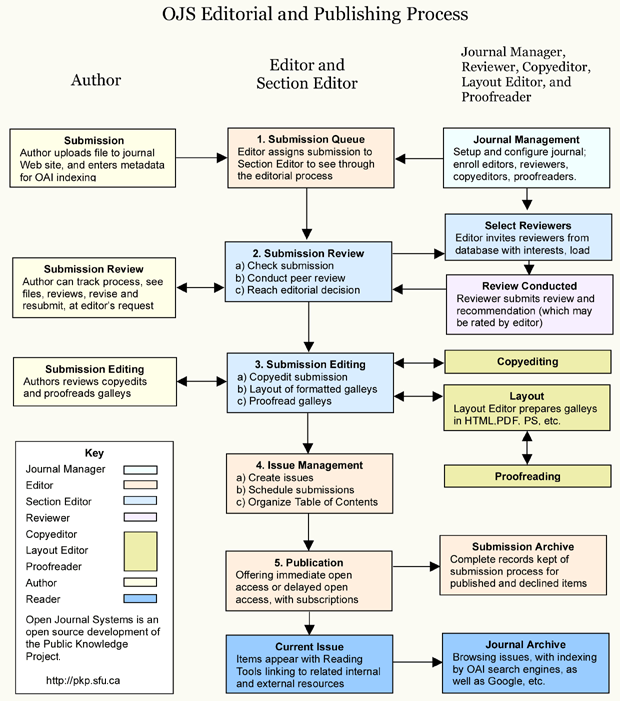
The peer-review process at HJCS consists of the following stages:
HJCS uses the Open Journal Systems (OJS) platform for manuscript submission and editorial management. Authors are required to register an account, log in to the submission system, complete the required metadata, and upload their manuscript in accordance with the journal's submission requirements.
Authors are responsible for ensuring that the submitted manuscript complies with the journal's Author Guidelines, including formatting, structure, references, ethical requirements, and other submission policies.
Upon submission, the Editorial Office conducts an initial assessment to determine whether the manuscript is suitable for further consideration.
The assessment includes:
Manuscripts that are clearly outside the scope of HJCS, substantially incomplete, or do not meet the journal's basic requirements may be rejected at this stage without external peer review.
Manuscripts that pass the initial editorial assessment are screened using Turnitin or an equivalent similarity-detection system.
HJCS generally requires a similarity index of no more than 20%. However, the similarity percentage is not used as the sole basis for determining plagiarism. Editors examine the sources and nature of the similarities to distinguish legitimate quotations, references, common terminology, and methodological expressions from inappropriate textual overlap.
Manuscripts containing substantial inappropriate similarity, plagiarism, duplicate publication, or other forms of academic misconduct may be rejected or returned to the authors for clarification and correction.
The Editor-in-Chief or designated editor evaluates the manuscript to determine whether it has sufficient originality, academic relevance, methodological soundness, and potential contribution to the field.
At this stage, the editor may make a preliminary decision to:
This editorial screening is intended to ensure that manuscripts sent to reviewers have a reasonable potential for publication.
For manuscripts proceeding to external review, the handling editor identifies appropriate reviewers based on their academic expertise, research interests, methodological competence, publication record, and absence of conflicts of interest.
HJCS normally invites three independent reviewers for each manuscript. Reviewers are expected to provide objective, impartial, and constructive evaluations.
The journal applies a double-blind peer-review system, meaning that:
The journal takes reasonable measures to protect the confidentiality and integrity of the review process.
Invited reviewers consider the manuscript in relation to their expertise, availability, and potential conflicts of interest.
Reviewers may:
Reviewers who identify a potential conflict of interest are expected to inform the editor and decline the assignment where impartiality may be compromised.
Reviewers conduct a detailed evaluation of the manuscript. They are expected to assess, among other aspects:
Reviewers provide constructive comments and recommendations through the journal's OJS review system.
Reviewers may recommend one of the following outcomes:
Accept · Minor Revision · Major Revision · Reject
The reviewer's recommendation is advisory. The final editorial decision remains the responsibility of the Editor-in-Chief or designated editor.
After the required review reports have been received, the handling editor evaluates the reviewers' comments and recommendations.
The editor considers the quality, consistency, and substantive content of the reviews, rather than relying solely on the reviewers' numerical recommendations.
If the reviewers provide substantially different recommendations or if additional expertise is required, the editor may invite an additional reviewer to provide an independent assessment.
The possible editorial decisions include:
The Editor-in-Chief or handling editor has the final authority to determine the editorial decision.
The corresponding author receives the editorial decision through the OJS system.
Where revisions are required, the decision letter will include relevant and constructive reviewer comments to guide the authors in improving the manuscript.
The reviewers' identities remain confidential under the double-blind review policy.
Authors are expected to respond carefully to each substantive reviewer comment and provide a revised manuscript together with a response to reviewers, explaining how each comment has been addressed.
When a manuscript is returned for major or minor revision, authors are expected to revise the manuscript according to the editorial and reviewer recommendations.
The revised manuscript may be returned to the original reviewers for further evaluation, particularly when substantial revisions have been requested.
For manuscripts requiring only minor corrections, the handling editor may evaluate the revised manuscript without returning it to the reviewers.
The number of revision rounds may vary depending on the extent of the required revisions and the editorial assessment.
After the revised manuscript has been evaluated and the editor is satisfied that the authors have adequately addressed the reviewers' and editorial comments, the manuscript may be formally accepted for publication.
Acceptance indicates that the manuscript has successfully completed the journal's editorial and peer-review requirements. However, the manuscript may still undergo editorial preparation before publication.
Accepted manuscripts proceed to the copyediting and production stage.
During this stage, the manuscript may undergo:
The corresponding author may be asked to review the final proof and confirm that there are no substantive errors before publication.
Once the production process has been completed, the article is published online as part of the appropriate journal issue.
HJCS is a fully open-access journal, and published articles are freely accessible to readers. Articles are made available through the journal's online platform and assigned appropriate publication metadata, including DOI information where applicable.