CHAT WHATSAPP

SCOPUS CITEDNESS

VISITOR STATISTICS

MANUSCRIPT TEMPLATE

DECLARATION FORM

QUALITY ASSURANCE PARTNERSHIP
SUPPORTED BY



OPEN RECRUITMENT

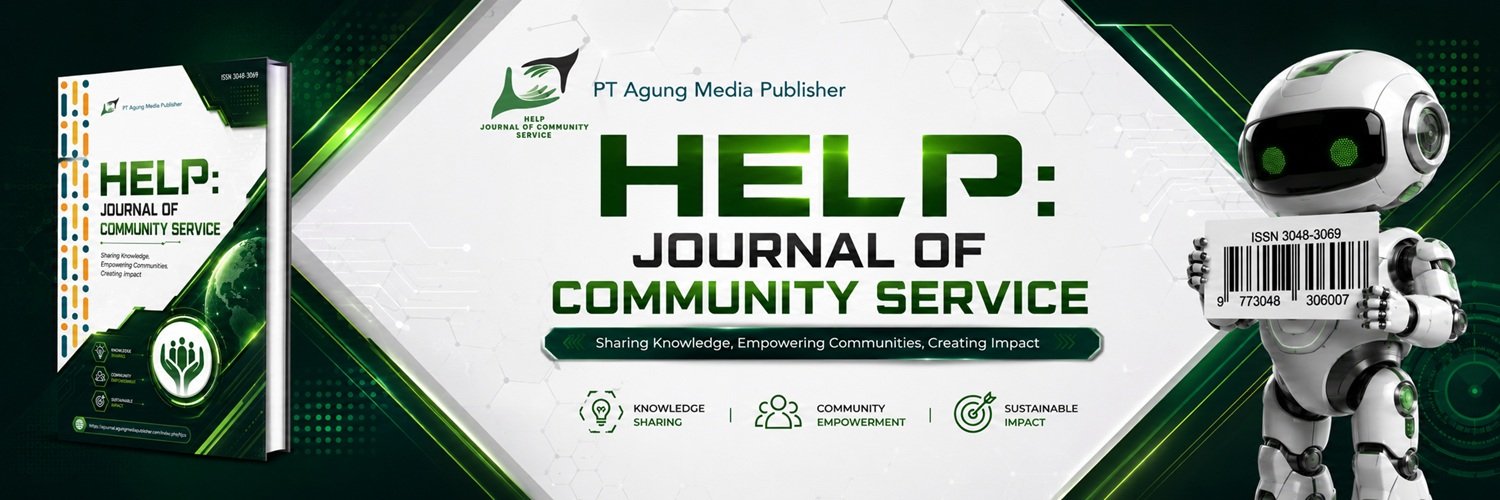
Help: Journal of Community Service (HJCS) recognizes that Generative Artificial Intelligence (Generative AI), including Large Language Models (LLMs), chatbots, AI writing assistants, image generators, coding assistants, and other AI-based technologies, can support researchers, authors, reviewers, editors, and publishers in various stages of scholarly communication.
HJCS permits the responsible use of Generative AI while maintaining the principles of academic integrity, transparency, originality, accountability, confidentiality, research ethics, and human responsibility.
The use of Generative AI does not transfer responsibility for scholarly work from humans to technology. Authors, reviewers, editors, and other contributors remain responsible for the accuracy, integrity, originality, confidentiality, and ethical standards of their work. This principle is consistent with current scholarly publishing guidance, which emphasizes that AI systems cannot assume authorship or responsibility for published research.
Authors may use Generative AI tools as an assistive technology during manuscript preparation, provided that such use is responsible, transparent, and does not compromise the originality or integrity of the manuscript.
Permitted uses may include:
language improvement and grammar correction;
spelling and punctuation checking;
translation assistance;
improving clarity and readability;
organizing ideas or outlines;
assisting with formatting;
assisting with coding or programming;
assisting with data-analysis procedures, provided that the analysis is independently verified;
generating preliminary ideas for research or community-service activities; and
other reasonable forms of editorial or technical assistance.
Authors remain fully responsible for verifying all AI-assisted content before submission.
AI-generated text may contain inaccurate, fabricated, biased, incomplete, or misleading information. Authors must therefore independently verify factual claims, references, quotations, data, interpretations, and other scholarly statements.
Generative AI tools, chatbots, or other artificial intelligence systems cannot be listed as authors or co-authors of manuscripts submitted to HJCS.
Authorship requires human responsibility for the accuracy, integrity, originality, and accountability of the published work. AI systems cannot assume these responsibilities.
Examples of AI systems that must not be listed as authors include, but are not limited to:
ChatGPT;
Claude;
Gemini;
Microsoft Copilot;
Perplexity;
other Large Language Models;
AI image-generation systems; and
other automated Generative AI systems.
The human authors remain responsible for all content generated or modified with the assistance of AI.
Authors must disclose the use of Generative AI when the technology has made a substantive contribution to the preparation, analysis, visualization, or production of the manuscript.
The disclosure should identify:
the name of the AI tool or system;
the version or model, where reasonably available;
the purpose for which the tool was used; and
the extent or nature of its contribution.
For example:
Generative AI Disclosure: During the preparation of this manuscript, the authors used [name of AI tool] for language editing and improvement of grammatical clarity. The authors reviewed, verified, and revised all AI-assisted content and take full responsibility for the final manuscript.
If Generative AI was used for substantive research activities such as data analysis, coding, data interpretation, image generation, or methodological procedures, the authors should describe its use in the appropriate Methods, Acknowledgments, or other relevant section of the manuscript.
Transparency regarding AI use is consistent with current scholarly publishing recommendations.
Authors must not use Generative AI to fabricate or manipulate scholarly content.
The following practices are prohibited:
submitting AI-generated material as entirely original human scholarship without appropriate disclosure;
fabricating references or citations;
inventing quotations, data, participants, findings, or research evidence;
manipulating research findings through undisclosed AI-generated content;
using AI to conceal plagiarism;
reproducing copyrighted material without appropriate permission or attribution;
misrepresenting AI-generated claims as verified scholarly facts; and
submitting content that the author cannot independently verify and defend.
Authors are responsible for ensuring that AI-assisted content does not contain plagiarism, fabricated citations, copyright violations, or inappropriate appropriation of other people's work.
Authors should not rely on Generative AI systems as authoritative sources for bibliographic information.
AI systems may generate incorrect, incomplete, or nonexistent references. Therefore, every reference generated or suggested by an AI system must be independently checked by the authors against the original scholarly source.
Authors must ensure that:
every cited source actually exists;
the cited source supports the relevant statement;
author names and publication details are accurate;
DOI information is correct where applicable; and
references comply with the journal's referencing requirements.
AI-generated material should not be treated as a primary scholarly source merely because it was produced by an AI system.
Generative AI may be used as a supporting tool for data analysis, coding, visualization, or methodological assistance when appropriate.
However, authors must independently validate the output and remain responsible for:
data accuracy;
analytical procedures;
statistical calculations;
coding;
interpretation of results;
methodological decisions; and
conclusions derived from the analysis.
If AI substantially contributes to data processing or analysis, its use should be transparently described in the Methods section.
AI must not be used to fabricate, selectively manipulate, or falsify research data or findings.
Authors must clearly disclose the use of Generative AI in producing images, figures, illustrations, diagrams, photographs, or other visual materials when such use is substantive.
AI-generated visual materials must not:
misrepresent research evidence;
fabricate research participants or field conditions;
manipulate scientific or documentary evidence;
violate copyright or intellectual-property rights;
infringe privacy or personality rights; or
mislead readers about the origin or authenticity of visual evidence.
Where an AI-generated image represents research data or evidence, authors must clearly distinguish between generated illustrations and genuine empirical evidence.
Authors, reviewers, and editors must exercise particular caution when entering information into external Generative AI systems.
Confidential manuscripts, unpublished research data, personal information, identifiable participant information, proprietary information, or other sensitive materials must not be uploaded to AI systems where confidentiality cannot be assured.
Authors should also avoid entering:
unpublished manuscripts;
confidential research datasets;
personally identifiable information;
confidential community-participant information;
interview transcripts containing identifiable information;
confidential institutional documents; and
proprietary research materials.
The confidentiality of submitted manuscripts is particularly important during peer review. Current scholarly publishing guidance warns that uploading confidential manuscripts into AI systems without adequate confidentiality safeguards may compromise authors' rights and the integrity of peer review.
Peer reviewers must protect the confidentiality of manuscripts assigned to them.
Reviewers must not upload or submit the full manuscript, substantial portions of the manuscript, unpublished data, figures, tables, or confidential information into Generative AI systems unless the journal and authors have explicitly permitted such use and confidentiality can be assured.
Reviewers may use AI tools for limited personal assistance only where such use does not compromise manuscript confidentiality or the integrity of peer review.
If AI is used in preparing reviewer comments, the reviewer remains responsible for the accuracy, fairness, originality, and confidentiality of the review.
Reviewers should disclose AI use to the editor when required by the journal.
These requirements reflect the principle that submitted manuscripts constitute privileged communications and must be protected during peer review.
Editors may use appropriate AI-assisted technologies for limited administrative or editorial purposes, provided that confidentiality, accuracy, fairness, and editorial independence are maintained.
Editors must not use AI in a manner that compromises:
manuscript confidentiality;
author privacy;
peer-review confidentiality;
editorial independence;
fairness in decision-making; or
the integrity of the publication process.
Editors remain responsible for all editorial decisions and may not delegate final decisions concerning acceptance, rejection, correction, or retraction of manuscripts to an AI system.
Where AI is used for editorial or production purposes, appropriate transparency should be maintained.
AI-generated recommendations must never be treated as a substitute for qualified human scholarly judgment.
HJCS does not permit automated AI systems to independently determine:
whether a manuscript should be accepted;
whether a manuscript should be rejected;
the scientific validity of a manuscript;
the credibility of an author;
the quality of research findings; or
the final editorial decision.
Human editors and qualified reviewers retain responsibility for scholarly evaluation.
HJCS may use appropriate technological tools to identify potential irregularities, plagiarism, or undisclosed AI-generated content as part of its editorial quality-control procedures.
However, AI-detection results shall not automatically be considered definitive evidence of misconduct.
AI-detection technologies may produce false positives or false negatives. Any concern regarding suspected inappropriate AI use will therefore be evaluated through human editorial judgment and, where necessary, communication with the authors.
Failure to disclose substantive use of Generative AI may result in editorial action when the omission materially affects transparency, originality, accountability, or research integrity.
Depending on the circumstances, HJCS may:
request clarification from the authors;
request revision of the manuscript;
require an AI-use disclosure statement;
refer the matter to the appropriate institutional authority;
reject the manuscript; or
initiate post-publication corrective action where necessary.
Any action will be considered on a case-by-case basis and in accordance with applicable publication ethics principles.
The use of Generative AI does not reduce or transfer the responsibility of authors, reviewers, or editors.
Human contributors remain responsible for:
Accuracy — ensuring that information is correct and verifiable.
Originality — ensuring that the work does not constitute plagiarism or inappropriate appropriation.
Integrity — ensuring that data, analysis, findings, and conclusions are not fabricated or manipulated.
Transparency — disclosing substantive use of AI.
Confidentiality — protecting unpublished manuscripts, data, and personal information.
Accountability — accepting responsibility for the final published content.
HJCS adopts the principle that AI may assist scholarly work, but AI cannot assume scholarly responsibility.
Authors who have used Generative AI may include the following statement:
Declaration of Generative AI Use: The authors used [AI tool/model name] during the preparation of this manuscript for [describe purpose, e.g., language editing, grammar checking, coding assistance, data-analysis support, or figure generation]. All AI-assisted outputs were critically reviewed, verified, and revised by the authors. The authors take full responsibility for the accuracy, originality, integrity, and final content of the manuscript.
If no Generative AI was used, authors may state:
Declaration of Generative AI Use: The authors declare that no Generative AI tools were used in the preparation, analysis, writing, or production of this manuscript.
HJCS recognizes that Generative AI technologies and scholarly publishing practices continue to develop rapidly. This policy may therefore be periodically reviewed and updated to reflect emerging technologies, ethical standards, legal developments, and recognized scholarly publishing recommendations.
The journal's objective is not to prohibit responsible technological innovation but to ensure that the use of AI strengthens scholarly communication without compromising academic integrity, research ethics, transparency, human accountability, and trust in the scholarly record.
Responsible AI — Transparent Use — Human Accountability — Academic Integrity — Research Ethics
HJCS welcomes responsible technological innovation while maintaining the fundamental principle that scholarly knowledge must remain transparent, verifiable, ethical, and accountable to the human community it seeks to serve.